This article is an in-depth exploration of our Authority Flywheel™ Framework.
Most businesses want more visibility, but very few understand how to build authority online in a way that creates long-term opportunities. They focus on reach, followers, and impressions while overlooking the one asset that compounds over time: authority. Understanding how to build authority online can help businesses earn trust, strengthen credibility, attract better opportunities, and create sustainable growth. That's exactly what The Authority Flywheel™ Framework was designed to achieve.
The Authority Problem Most Businesses Don't Realise They Have.
Many businesses assume they have a lead generation problem. Others believe they have a content problem. Some think they have a visibility problem. In reality, many of them have an authority problem.
The challenge is that authority problems rarely announce themselves clearly. Instead, they show up in indirect ways. A business may have a decent website, a strong offer, a capable team, positive testimonials, and consistent marketing — yet growth remains slower than expected.
The immediate reaction is usually to increase activity: create more content, run more campaigns, increase posting frequency, launch more promotions. However, if authority is weak, none of those actions solves the underlying issue.
Authority influences how people interpret everything else. When authority is low, prospects question claims more heavily, compare alternatives more aggressively, hesitate before making decisions, and need additional reassurance before moving forward.
When authority is strong, the opposite happens. Prospects arrive with greater confidence. Sales conversations become easier. Referrals happen more frequently. Recommendations carry more weight. Trust develops faster.
Authority changes perception. And perception influences behaviour.
Imagine two businesses offering nearly identical services. One has spent years consistently educating its audience and building trust. The other has spent years simply promoting its services. Who do you think people trust more? Who receives more referrals? Who finds it easier to command premium pricing?
The answer is obvious. Authority doesn't just affect marketing — it affects every part of business growth. That's why authority should never be treated as a vanity metric. It's one of the most valuable business assets a company can build.
What Is The Authority Flywheel™ Framework?
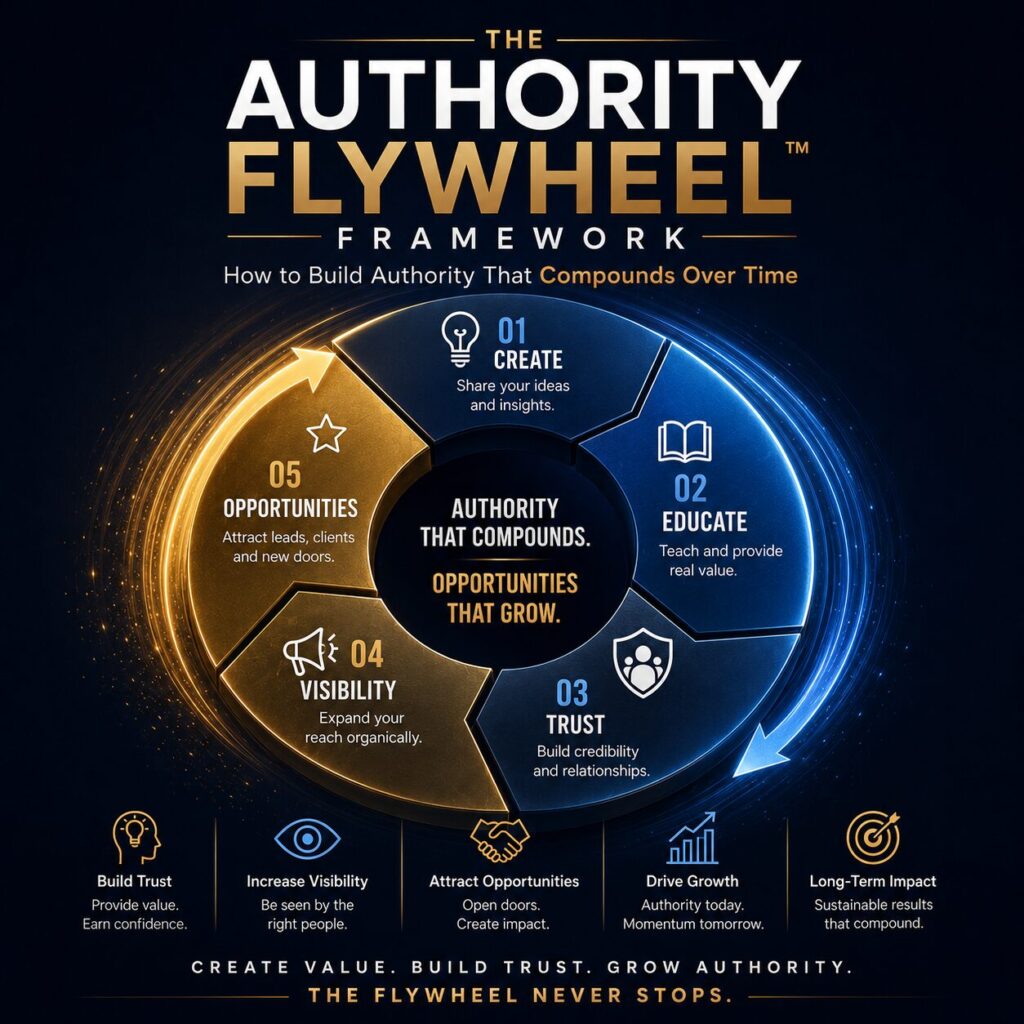
The Authority Flywheel™ Framework is a strategic model that explains how businesses build authority in a way that compounds over time. Unlike traditional marketing approaches that focus primarily on generating attention, the flywheel focuses on creating a self-reinforcing cycle that continuously strengthens authority.
The framework consists of five stages:
Create → Educate → Trust → Visibility → Opportunities.
Each stage supports the next. Creation produces ideas. Ideas educate. Education builds trust. Trust expands visibility. Visibility creates opportunities. Those opportunities generate new experiences, lessons, insights, and stories that become future content. The cycle repeats — and every cycle makes the next one stronger.
That's the difference between a flywheel and a campaign. Campaigns end. Flywheels continue generating momentum. The longer the flywheel spins, the more powerful it becomes. This is why authority often feels slow at first and then suddenly accelerates — the momentum compounds. One valuable article becomes ten. Ten become fifty. Fifty become a recognised body of work.
Every Authority Begins With Creation.
Authority doesn't begin with visibility. It begins with contribution. Before someone can trust your expertise, they need to experience it. Before they can experience it, you need to share it. That's why the first stage of the flywheel is creation.
Many businesses mistakenly believe content creation requires endless originality or constant inspiration. It doesn't. In reality, most businesses already possess a wealth of valuable insights: every client challenge, every project, every lesson learned, every mistake, every success, every frequently asked question.
The strongest authorities in any industry aren't necessarily the smartest people. They're often the people who consistently share what they know. They document. They explain. They teach. They contribute. Over time, their expertise becomes visible — not because they claim authority, but because they demonstrate it.
Creation is how expertise becomes visible. Without creation, authority remains hidden. No matter how knowledgeable someone is, authority cannot develop if nobody experiences that knowledge. Every article, every email, every insight, every framework, every story, every perspective — each one becomes an asset capable of educating, building trust, and generating future opportunities.
Education Creates Value.
Creating content is only the beginning. Content becomes powerful when it helps people. This is where education enters the framework. Education transforms information into value — it helps people understand something they didn't understand before, avoid mistakes, solve problems, make better decisions, and gain clarity.
The businesses that build authority don't simply share information. They teach. They simplify complexity. They make difficult ideas easier to understand. This is one reason educational content consistently outperforms promotional content over the long term.
People naturally gravitate toward sources that help them improve. Every useful insight creates a positive experience. Every positive experience strengthens trust. Over time, those experiences compound, and the audience begins associating the business with value. And value creates authority.
When people learn from you consistently, they begin trusting your expertise long before they become customers. By the time a buying decision arrives, much of the trust-building process has already happened.
Education shortens sales cycles because it reduces uncertainty. It demonstrates competence. It builds confidence. And confidence influences decisions.
The Foundation of Authority.
Trust is where authority truly begins to emerge. Without trust, visibility means very little. Without trust, expertise goes unnoticed. Without trust, opportunities remain limited. Trust is the bridge between value and authority — it's what transforms helpful content into meaningful relationships.
Most businesses underestimate the importance of trust because trust is difficult to measure directly. You can't easily track it the way you track clicks, impressions, or website traffic. However, trust influences nearly every business outcome: conversions, referrals, retention, pricing power, and reputation.
People don't trust businesses because of a single interaction. Trust develops through repeated experiences — every helpful article, every valuable email, every thoughtful conversation, every fulfilled promise. Each interaction becomes a deposit in what could be called a trust account. Over time, those deposits accumulate, the relationship strengthens, confidence grows, and authority begins to emerge naturally.
The businesses that win in the long run aren't always the loudest. They're often the most trusted. Because trust creates influence. And influence creates opportunities.
Why Visibility Comes After Trust.
This is one of the most misunderstood parts of The Authority Flywheel™ Framework. Most marketing advice places visibility at the beginning of the journey: get seen, get noticed, reach more people, increase impressions, grow your audience. While visibility is certainly important, placing it before trust often creates the wrong priorities.
Businesses become obsessed with reach. They chase views. They focus on numbers. And in the process, they forget the thing that actually influences decisions: trust. Visibility without trust is fragile — a post may go viral, a video may generate thousands of views, a campaign may attract attention, but if trust hasn't been established, very little changes. People notice the business, then they move on.
Trust changes that dynamic completely. When people trust a business, they engage differently — they spend more time consuming content, they share it, they recommend it, they refer others, they return for more. As trust grows, visibility expands naturally.
Trust amplifies reach. Trust increases distribution. Trust creates advocacy. People become willing participants in spreading your message — they do the marketing for you.
Think about the experts, brands, and businesses you follow closely. You probably discovered them through visibility. But you stayed because of trust. And eventually, because you trusted them, you recommended them to others. That's how visibility compounds — not through algorithms alone, through people.
The Outcome of Authority.
Many businesses assume opportunities are random: a lucky referral, an unexpected inquiry, a podcast invitation, a partnership request, a speaking opportunity. The reality is usually very different. Most opportunities are the result of authority.
People trust businesses they know. People recommend businesses they trust. People remember businesses that consistently provide value. Authority increases the likelihood that your name enters conversations when opportunities arise.
The opportunities created by authority can take many forms — more inbound leads, stronger referral networks, speaking engagements, media features, or attracting higher-quality clients. The important thing to understand is that opportunities are rarely the result of a single piece of content. They're the result of hundreds of small trust-building interactions that happen over time.
Someone reads an article. Sees a LinkedIn post. Subscribes to an email list. Learns from a framework. Reads a case study. Then six months later, they need help. Who do they think about? The business that consistently demonstrated expertise. The business they trust. The business that stayed visible. That's authority at work.
Why Is It Called a Flywheel?
Most marketing models are built around funnels. Funnels are linear — people enter at the top, move through a process, exit at the bottom, then the cycle starts again. Funnels have value, but they often encourage short-term thinking, focusing on moving prospects through a process rather than building an asset that becomes stronger over time.
A flywheel works differently. A flywheel gains momentum — every rotation makes the next rotation easier. The Authority Flywheel™ Framework follows the same principle: every piece of content creates value, that value educates, education builds trust, trust expands visibility, visibility creates opportunities, and those opportunities generate new experiences, stories, lessons, and insights that become future content.
This is why authority often feels slow at first. Momentum takes time to build. In the early stages, the effort feels greater than the reward. However, once the flywheel gains speed, the opposite becomes true — past work continues generating value, old content remains discoverable, and existing authority continues attracting opportunities.
Real Client Examples.
Pedro F. already had expertise. He already delivered results. What he lacked was authority — his audience couldn't clearly see the value he provided, and as a result, opportunities were being missed.
We focused on strengthening his personal brand through strategic content and authority-building initiatives. The goal wasn't visibility for the sake of visibility — the goal was trust. As trust increased, authority strengthened, and as authority strengthened, opportunities increased.
33.4% revenue increase in 3 monthsChris S.'s expertise was substantial, but his audience wasn't fully aware of it. Potential clients couldn't easily see the depth of his knowledge — a gap between capability and perception.
Through authority-building content, personal branding, and strategic positioning, we helped communicate expertise more effectively. The objective wasn't to sell harder — it was to educate better.
39.65% revenue increase in 77 days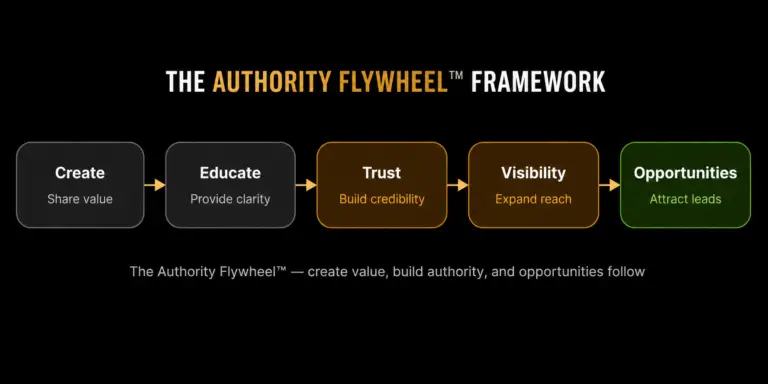
How The Authority Flywheel™ Connects to Our Other Frameworks.
The Authority Flywheel™ Framework doesn't exist in isolation. It's part of a larger growth ecosystem. At Crafted By Words, each framework solves a specific problem, and together they create a complete system for sustainable growth.
The Biggest Mistake Businesses Make When Learning How to Build Authority Online.
One of the biggest mistakes businesses make is confusing activity with progress. Publishing more content doesn't automatically create authority. Posting every day doesn't automatically build trust. Being visible doesn't automatically make a business memorable. Authority requires intention.
Another common mistake is chasing trends at the expense of expertise. Trends may create temporary attention, but authority is built by consistently contributing valuable insights. Businesses that constantly shift focus often struggle to become known for anything specific — authority requires clarity.
Many businesses also focus too heavily on selling, turning every piece of content into a promotion. This approach weakens trust. Authority is built by helping first — selling becomes easier when trust already exists. Inconsistency is another major obstacle: authority compounds through repetition, and showing up occasionally is rarely enough.
How to Implement The Authority Flywheel™ Framework.
Start by documenting what you already know. You don't need more ideas — you need better use of existing knowledge. Identify the questions your audience asks most often. Document the lessons you've learned. Share insights from client work. Explain your thinking. Teach what you know. Focus on helping rather than impressing.
Then commit to consistency. Not perfection — consistency. The goal isn't creating viral content; the goal is building trust. Over time, trust creates visibility, visibility creates opportunities, and those opportunities create new lessons. The flywheel continues spinning.
The businesses that win aren't necessarily the businesses with the largest audiences. They're often the businesses that stay committed to the process long enough for authority to compound.
The Future Belongs to Trusted Authorities.
Attention has become easier to buy. Authority remains difficult to earn. That's exactly why it matters. The internet has created more competition than ever before — endless options, endless choices, endless information. Trust has become one of the most valuable currencies in business.
The businesses that thrive in the future won't simply be the loudest. They'll be the most trusted, the most helpful, the most credible, the most memorable. Because people rarely choose the business they see once — they choose the business they trust. And trust is the foundation of authority.
Final Thoughts.
Most businesses spend years chasing visibility. Very few spend enough time building authority. That's unfortunate, because visibility fades and authority compounds. Visibility gets attention; authority keeps attention. Visibility creates awareness; authority creates preference. Visibility starts conversations; authority creates opportunities.
The Authority Flywheel™ Framework exists to help businesses build a system that continuously strengthens trust, expands visibility, and generates opportunities — not through shortcuts, not through hacks, not through chasing every trend, but through consistently creating value, educating people, building trust, expanding visibility, and attracting opportunities. Again and again.
That's the power of authority. And that's the power of a flywheel.